

What is a Ping Tree
A ping tree (sometimes written as pingtree) is a lead distribution method used to sell a single lead to the right advertiser in real time. Instead of sending every lead to one buyer, a ping tree lets you offer the same lead to multiple advertisers and decide who gets it based on the distribution logic you choose.
Think of it as a smart router for lead monetization. You control which advertisers can receive the lead, what rules must be met, and how the winner is selected. The outcome is simple: the lead is either sold and delivered to an advertiser, or it continues through the routing until a valid sale happens, or the flow ends with a clear status.
Ping trees are most common in markets where multiple advertisers buy the same type of lead, such as insurance, lending, home services, solar, telecom, and education. They are used by lead brokers, affiliate networks, performance teams, and lead sellers who need to maximize revenue while keeping acceptance rates, caps, and buyer requirements under control.
Ping tree is not CRM lead routing (assigning sales leads to sales reps). It is real-time lead distribution to advertisers, designed for lead buying and selling workflows.
Ping Post Explained: The Ping Post Basis
A ping tree runs on a simple selling mechanism called Ping Post. The rule is straightforward:
Ping is optional. Post is required. Ping is the “offer” phase. Post is the “sale and delivery” phase.
In practice, Ping Post means you can first ask one or more advertisers whether they want the lead, and only if they respond positively do you send the full lead payload. This is useful because many buyers have strict rules, caps, and quality requirements, and you do not want to transmit full personal data to a buyer who is not eligible to buy the lead right now.
Ping vs Post: what each step does
Ping is a lightweight request that offers the lead. It typically contains only the minimum data needed to evaluate the lead, for example:
- product or vertical identifier
- location signals (country, region, postal code)
- basic qualifiers (age range, vehicle type, property type, etc.)
- traffic metadata (source, partner id, click id, timestamps)
It usually excludes contact details so the advertiser cannot reject the lead and still process it outside the broker.
The Ping response tells you whether the buyer is willing to purchase the lead right now. Depending on the setup, it may include:
- accept or reject decision
- a price or bid amount
- rejection reason codes
- cap or availability flags
Post is the actual sale. This is where you send the complete lead payload to the selected advertiser endpoint. The post request usually includes:
- full user-provided data (including contact details)
- routing context (which channel won, what logic was used, bid or price, timestamps)
- identifiers used for reconciliation and reporting
After the post is sent, the buyer returns the final status, accepted or rejected. With an accepted ping, a rejection on post should be uncommon and usually points to validation or consistency issues.
Why Ping exists
Ping is not “extra complexity for fun”. It exists because it improves control and revenue in real lead selling operations:
- Caps and eligibility: you avoid posting to buyers that are capped or will reject the lead
- Speed and reliability: you can pick a working buyer when one endpoint is slow or down
- Privacy and compliance: you can avoid sharing full personal data until a buyer commits
- Monetization: you can compare multiple buyers and choose the best outcome
In short, Ping Post is the mechanism that makes a ping tree possible: you can offer the lead, learn who is willing to buy, then complete the sale with a post to the winning channel.
Filters
Before any ping happens, most ping tree setups run filters to avoid wasting time and requests on channels that would reject the lead anyway. These filters evaluate the incoming lead against each channel’s basic requirements such as country or region, product eligibility, required attributes, device or traffic constraints, or any other rule you define. Each ping or post request adds latency while the user is waiting on a loading screen.
Distribution Logics in a Ping Tree
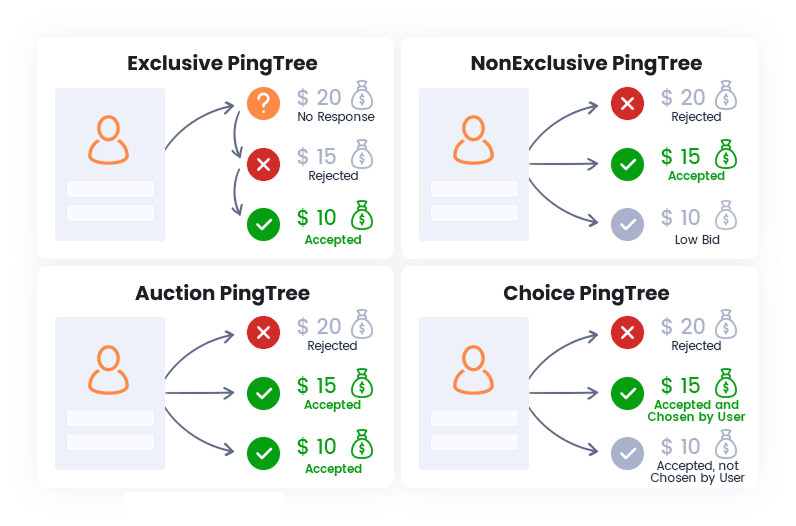
A ping tree always follows the same foundation: Ping is optional, Post is required. What changes is the distribution logic, meaning how the system decides which advertiser gets the lead, and what happens if multiple advertisers are eligible at the same time. The four most common logics are Exclusive, Non-Exclusive, Auction, and Choice.
Exclusive
In Exclusive distribution, advertisers are evaluated one at a time. Typically, the ping tree starts with the channel that is expected to earn the most, based on your performance model (for example the highest expected profit per lead, not necessarily the highest raw commission). If the first advertiser accepts the lead, the flow ends and the lead is posted to that channel. If the advertiser rejects or does not respond in time, the ping tree continues to the next channel until a successful sale happens or the list is exhausted.
Non Exclusive
In Non Exclusive distribution, the lead is offered to multiple advertisers at the same time, regardless of ordering in the ping tree. Multiple advertisers can accept the same lead simultaneously. This logic is useful when you want maximum reach or parallel qualification, and when your user experience supports showing multiple successful results instead of forcing a single winner.
Auction
In Auction distribution, the lead is offered to multiple advertisers (ping) and each returns a price or bid. The ping tree then selects the winner using auction rules, most commonly the highest bid, and posts the full lead to the winning channel. Auction logic is often used when buyers value each lead differently and price competition is strong enough to increase your effective revenue per lead.
Choice (User Pick)
In Choice distribution, the lead is offered to multiple advertisers (ping), and the user sees the channels that successfully responded on a Choice page. The user then chooses where they want to apply, and the lead is posted only to the selected channel or channels. This is effectively the Ping Pick Post pattern, because the “pick” is performed by the user, not by price or routing priority.
Real Time Lead Distribution
Real-time lead distribution is the process of deciding where a lead should go immediately after the user submits it, while they are still waiting for the next screen. A ping tree does this by running a short decision pipeline that filters out impossible channels, offers the lead to eligible buyers, and then completes the sale with a post to the final channel.
A typical pipeline looks like this:
- Lead is created from a form submission or an API intake.
- Filters run to remove channels that would obviously reject the lead.
- Validation and deduplication check that the data is usable and not a repeat.
- Eligible channels are pinged based on the chosen distribution logic (exclusive, non exclusive, auction, or choice).
- A winner is selected by the system (exclusive or auction) or by the user (choice).
- The lead is posted to the winning or selected channel as the actual sale.
- The final status is confirmed via the post response or a callback, and the lead lifecycle is updated.
- Delivery logs are stored so you can see exactly what happened, including rejects, timeouts, retries, and outcomes.
Because every request adds latency, real time lead distribution is always a balance between maximizing revenue (pinging more buyers, running auctions, adding fallbacks) and minimizing user wait time (filtering early, using tight timeouts, and avoiding unnecessary pings).
Common Failure Modes (and Fixes)
Ping trees are simple in concept, but in production the same problems show up repeatedly. The good news is that most issues have clear, predictable fixes once you know what to look for.
High reject rate
If many pings or posts come back rejected, it usually means the lead does not match buyer requirements, required fields are missing, consent signals are incomplete, or your filters are too loose. Tighten filters, validate required fields earlier, and make sure each buyer’s spec is reflected in your routing rules so ineligible leads never reach the ping stage.
Timeouts and buyer outages
Slow buyer endpoints create long loading screens and lost sales. Use strict timeouts, retries only where they make sense, and always configure fallbacks so a single failing buyer does not block the whole flow. Monitor response times per channel and temporarily downgrade or disable unstable endpoints.
Duplicates and disputes
Duplicate leads waste money and damage buyer trust. Add deduplication windows and suppression lists using stable identifiers such as phone, email, or external ids, and keep the logic consistent across all channels. If buyers also run their own dedupe, align your rules so you do not send leads that are guaranteed to be rejected.
“Where did my lead go”
If you cannot explain why a lead was rejected or where it was sold, you are missing traceability. Store delivery logs for each ping and post, capture rejection reasons, timestamps, and routing decisions, and keep a clear lead lifecycle so every lead has an auditable history.
Choosing Ping Tree Software
When people search for ping tree software, they are usually trying to solve one thing: reliably selling leads to multiple advertisers in real time without losing money to rejects, timeouts, or messy operations. A good ping tree platform is not just “routing”, it must combine distribution logic, integration tooling, and full traceability so you can scale without guessing.
Here is what to look for:
- Ping Post API support: the ability to run ping and post requests with flexible payloads, headers, and authentication.
- All core distribution logics: Exclusive, Non Exclusive, Auction, and Choice, plus the ability to combine them when needed.
- Filters, validation, and deduplication: so ineligible or duplicate leads are never sent to buyers and do not waste user time on a loading screen.
- Caps, pacing, and prioritization: to respect buyer limits and control how volume is distributed over time.
- Reliability controls: strict timeouts, retries, idempotency, and fallbacks so a single endpoint cannot break your flow.
- Delivery logs and rejection reasons: so every lead has a full audit trail showing what was pinged, what responded, what was posted, and why.
- Reporting tied to revenue: acceptance rate, effective price, buyer performance, latency, and outcomes, so you can optimize toward profit, not vanity metrics.
If you operate more like a marketplace, you may also need buyer management, invoicing, and payout workflows, but the foundation is always the same: fast real time distribution, accurate outcomes, and complete transparency.
PalDock was built specifically for this lead distribution use case. It supports Ping Post execution, Exclusive, Non Exclusive, Auction, and Choice flows in a single ping tree, and adds a visual no code integration layer for payload mapping, signing, retries, and callbacks, so you can connect buyer APIs and adjust routing rules quickly without turning every change into an engineering project. Learn more about how we handle ping tree in Paldock.
What is a ping tree
A ping tree (pingtree) is a real time lead distribution method that lets you offer one lead to multiple advertisers and decide who gets it using rules such as exclusive routing, non exclusive distribution, auction bidding, or user choice.
Ping tree vs ping post: what’s the difference
Ping post is the delivery method. Ping tree is the system that uses ping post to choose the best advertiser when multiple buyers are available
What is ping post API
Ping post API is the set of requests used to sell a lead in two steps: a ping request to check eligibility or pricing, followed by a post request that delivers the full lead to the winning or selected advertiser.
What is real time lead distribution
Real time lead distribution is the process of routing and selling a lead immediately after it is created, while the user is still waiting for the next screen, using fast filtering, selection logic, and buyer API calls.